
The short answer: moderate for a tank swap, hard to do safely
Replacing a tank water heater in the same spot with the same fuel is one of the more doable home plumbing jobs. It is also a job where a small mistake can scald someone, flood a garage or leak gas. That mix is why the honest rating is moderate difficulty and high consequence.
The job breaks into six parts: draining and disconnecting the old unit, moving a tank that can weigh well over a hundred pounds when full, connecting water, connecting gas or power, venting if the heater burns gas, and testing. Each part has a failure mode that does not show up until later.
How hard each part of the job really is
Here is a plain rating for each step, based on the tools and skill involved.
| Step | Difficulty | What goes wrong |
|---|---|---|
| Drain the old tank | Easy | A stuck drain valve or sediment can stop the flow |
| Move the tank | Moderate | Weight and tight doorways cause back injuries and dented walls |
| Connect water lines | Moderate | Poor soldering or wrong fittings leak slowly behind the tank |
| Connect power (electric) | Hard | Wrong wire size or a loose lug can overheat a connection |
| Connect gas and vent (gas) | Hard | A gas leak or a backdrafting vent is a safety hazard |
| Set the relief valve and test | Moderate | A blocked discharge line defeats the safety device |
Rather not wrestle a 50-gallon tank?
Call the 24/7 line and we will schedule the installation or an emergency replacement.
Gas versus electric: what changes in the install
The fuel changes the work more than the tank does.
Electric tank install
- Needs the right breaker and wire size already in place.
- No vent pipe, so the tank can go in tighter spaces.
- The main risk is a loose electrical connection or working on a live circuit.
Gas tank install
- Needs a gas line, a sediment trap, a shutoff and a flue to the outdoors.
- Every gas joint must be tested for leaks before the heater runs.
- The main risk is a gas leak or a flue that does not draw.
Parts people skip: relief valve, expansion tank and drain pan
The temperature and pressure relief valve is the safety device that opens if the tank overheats or overpressurizes. It needs a discharge pipe that runs down to a safe spot and nothing that can block it. Capping that pipe or running it uphill defeats the whole point of the valve.
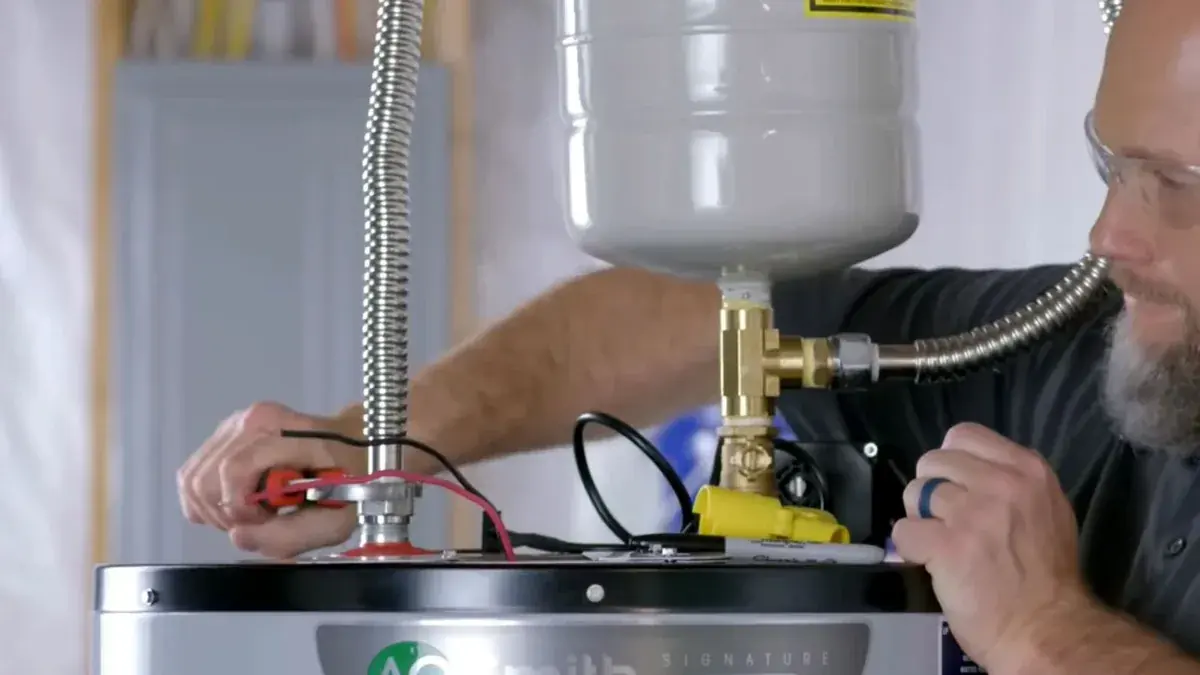
An expansion tank absorbs the extra volume of water as it heats in a closed system. If your home has a backflow device or pressure-reducing valve on the incoming line, a small expansion tank is often part of a proper installation. A drain pan under the heater in a living space catches a slow leak before it reaches the floor.
These are the parts that separate a clean installation from one that works for a month. They are also the parts a rushed DIY job tends to leave out.
What a professional installation looks like
- 1
Size and plan
Pick the tank size from how many people live in the home and how many fixtures run at once.
- 2
Shut off and drain
Turn off the fuel and water, drain the old tank and cut it free.
- 3
Set and connect
Place the new heater on a stand or pan, connect lines, valves and the expansion tank.
- 4
Fill and test
Fill the tank before any power or fire, then check every joint, vent and relief line.
When not to do it yourself
Skip the DIY route if the heater is gas and the flue or gas line must change, if the old unit sits in an attic or tight closet, or if you are not sure the electrical supply matches the new tank. Also skip it when the tank is leaking now. A failing tank can burst while you work, so treat it as an emergency and call for water heater replacement.
You may also prefer a tankless unit that mounts on a wall. That changes the gas and venting requirements and the drain and descale routine, and it is covered on our tankless water heater page.
Coconut Creek note: ask the building department
Whether a water heater swap needs a permit depends on the city that issues it. The Margate Building Department, for example, lists a Water Heater permit application among its posted forms, which is a sign that permits can apply there. We do not make that claim for every town, because rules vary.
For a home in Coconut Creek, the Building Department at the Government Center, 4800 West Copans Road, can answer the question. Call 954-973-6750 and ask before you buy a tank. A short call before you start is cheaper than being asked to redo the work after.
Source: City of Margate Building Department permit applications page and City of Coconut Creek Building Department contact page.
Before you buy a new tank
These checks keep the purchase from turning into a second trip to the store.
- Measure the space, including height with the flue or relief line attached.
- Note the fuel, the venting type and the voltage, if electric.
- Check the date on the old tank, since a heater past its normal life often fails soon after.
- Ask whether the old unit is leaking or just losing heat, since that decides whether to repair or replace. Our water heater repair page explains the difference.
- Ask your Building Department whether a permit is needed before work starts.
What neighbors in nearby towns ask us
Homeowners in Deerfield Beach and Parkland ask most often about size and cost. Size comes from household use. Cost depends on the tank, the fuel, any venting or wiring changes and the access to the heater, which is why a clear price after a quick look is more useful than a number over the phone.
Water heater installation questions
You can for a simple like-for-like electric swap if you are comfortable with plumbing and power. Gas units, venting changes and tight spaces are better left to a plumber, because errors carry a safety risk.
A straightforward swap is usually a few hours of work, including draining the old tank and testing the new one. Changes to venting, gas lines or wiring add time.
Often, when the home has a closed system with a backflow device or pressure-reducing valve. We check your incoming pressure and system setup and install one when it is appropriate.
The pipe carries hot water or steam to a safe place when the valve opens. It must run downward, stay uncapped and end where the discharge will not hurt anyone.
It depends on the fuel you already have, your hot water use and your budget. We walk through the trade-offs on a visit, and our water heater installation page lists what each option involves.
We do not state a rule, because the answer comes from the city. Call the Coconut Creek Building Department at 954-973-6750 and ask before you start. We can tell you what the work involves, and the building department tells you what paperwork it needs.