
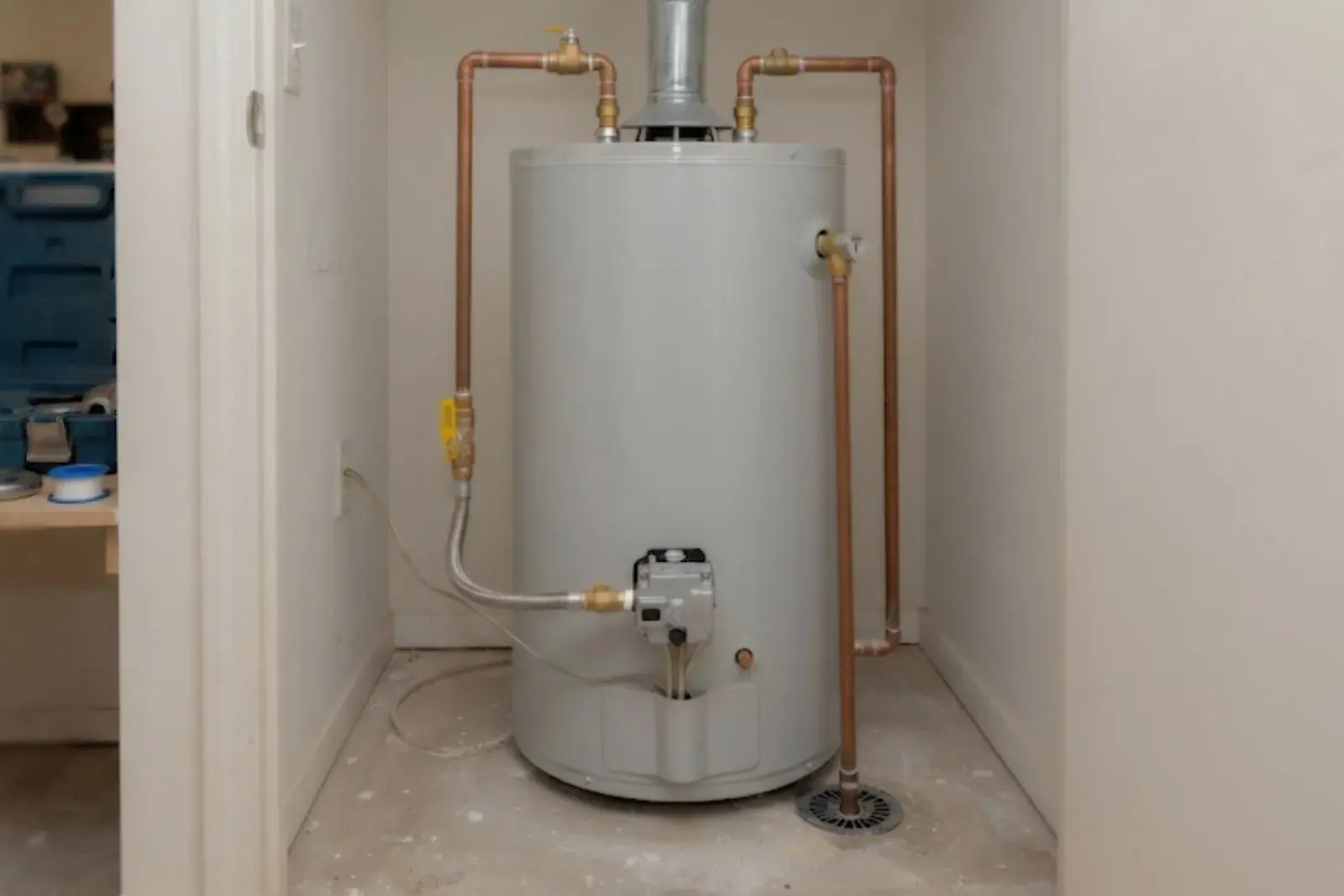
Emergency water heater replacement in Coconut Creek: what it means
Water heater replacement is the removal of a failed tank or tankless unit and the installation of a new one, with the plumbing, venting or wiring brought up to a safe condition. In Coconut Creek, FL, emergency water heater replacement is usually triggered by a leaking tank, a corroded base or a unit that no longer heats after repeated repairs.
Our line is open 24/7, and we offer same-day replacement appointments when we can. If the old heater is leaking, close its cold water valve and shut off power or gas before you call.
When a failed water heater is an emergency
A tank that has given out can lose its whole contents onto the floor in a short time. Take these steps while you wait.
Stop the water coming in
Close the cold inlet valve above the tank. If that valve is stuck, close the main water shutoff for the house.
Switch off the energy source
Turn off the breaker for an electric unit. For gas, set the control to off and close the gas shutoff. Smell gas and you leave the house and call the gas utility or 911.
Drain the safe way
Do not open the drain valve on a hot tank. Wait for the water to cool, and keep people clear of any discharge pipe.
Photograph for your records
Capture the data label, the leak and any water damage before you move anything.
A leaking supply line near the heater can look like a tank failure, so we also check for a pipe fault and can handle burst pipe repair on site.
Repair the old unit or replace it
Replacement is not always the answer. We tell you plainly when a repair makes sense.
When replacement is the better call
- The tank body is leaking or rusted at the base.
- The unit has needed several repairs in a short time.
- The tank is near the end of its typical service life.
- It runs out of hot water because the household has grown.
- Parts are no longer available for the model.
When a repair is smarter
- A single failed element, thermostat or igniter on a sound tank.
- A worn relief valve or drain valve that is dripping.
- A tripped breaker or a pilot that needs relighting.
- A tankless unit with a scale or flow issue, not a dead heat exchanger.
- A newer unit where the manufacturer covers the failed part.
Choosing the right size and type
Size follows how many people use hot water and how often, not how big the house is. A household with two showers running back to back needs more recovery capacity than the same house with one.
We look at the old unit's capacity, the number of bathrooms and your habits, then match the replacement. Going a size up costs more and can waste energy, while going too small brings cold showers.
Tank, tankless or heat pump: how they compare
All three can work in a Coconut Creek home. The right one depends on space, fuel and how you use hot water.
| Type | Strengths | Trade-offs |
|---|---|---|
| Standard tank (electric or gas) | Lower upfront cost, simple to service | Stores and reheats water, so it can run out |
| Tankless | Endless hot water in a smaller footprint, see tankless water heater | Higher upfront cost and needs periodic descaling |
| Hybrid heat pump | Uses less electricity to heat water | Needs airflow around the unit and a condensate drain |
We price each option so you can compare before choosing.
Gas to heat pump and other switches
Some homeowners ask to replace a gas tank with a heat pump unit, or an electric tank with tankless. These are possible, but each switch changes what the plumbing and electrical must supply.
A gas-to-electric change means a dedicated circuit and a plan for the old gas line and vent. An electric-to-gas change needs a gas supply, a vent path and combustion air. We walk through those requirements with you at the visit, and for permit questions we point you to the local Building Department.
What is replaced and what is checked
A proper swap is more than lifting one tank out and another in.
- 1
Drain and remove
The old unit is shut off, drained and disconnected, then hauled away.
- 2
Replace the weak parts
Flexible connectors, shutoff valve, relief valve and discharge line are renewed where worn.
- 3
Add protection
We fit an expansion tank where the system calls for it and a drain pan under the tank.
- 4
Connect and test
Water, power or gas and venting are connected, then temperature and relief valve operation are tested.
Local points for Coconut Creek replacements
These details change how we plan a swap.
City permits
The Coconut Creek Building Department says permits cover alterations and replacements, including plumbing. We recommend calling them at 954-973-6750 to confirm what your swap needs. Permit rules are theirs to state, not ours.
Hurricane season
The Atlantic season runs June 1 to November 30, so heaters that sit low in a garage deserve a drain pan and raised placement where possible. A heater that sat in floodwater needs inspection before use.
Water treatment
The city utility buys water from Broward County, where it is treated to reduce hardness and disinfected with chloramines. Ask the utility for the annual water quality report if you are comparing tank materials or filters.
Garage and closet space
Many replacements are in tight garage corners. We measure clearances for venting and service access before choosing the model.
What affects the cost of water heater replacement
The price comes from the unit and the work around it. These are the main factors.
Unit type and capacity
A standard tank costs less than a tankless or heat pump unit of similar capacity.
Fuel and venting changes
Switching fuels adds electrical or gas and venting work.
Code upgrades
Pans, expansion tanks, valves and discharge lines are added where needed.
Location and access
Attic or tight closet installs take longer than a garage floor.
Permit and removal
Permit fees where required and old unit disposal are included in the quote.
A sudden leak that damages floors is often a covered loss under a homeowner policy, but the cost of the heater is usually not. Slow leaks and age-related failure tend to be excluded, so check the wording with your insurer.
Want a firm number? Call with the tank size and fuel type.
Call (855) 575-2890Old unit removal and disposal
Old heaters are heavy and hold sediment. We drain and carry out the old unit as part of the job, so you are not left with a rusted tank in the garage.
Water heater replacement questions from Coconut Creek homeowners
Yes. Our line runs 24/7 and we take water heater emergencies on nights, weekends and holidays. Shut off the cold water and the power or gas, then call and tell us the tank size and fuel type.
Most standard tank swaps are done in a single visit, and we plan the schedule after we see the setup. Fuel changes, relocations or tankless installs can take longer. We tell you the plan before starting.
Often yes. It requires a circuit, space for airflow and a condensate drain, plus a plan for the old gas line and vent. We review the setup and give you the details at the visit.
Yes. We drain it, disconnect it and take it away as part of the job.
Permit rules are set by the city. The Coconut Creek Building Department says permits cover plumbing alterations and replacements, so call them at 954-973-6750 before work to confirm what applies to your home.
Leaks from the tank body will only get worse. Shut off the cold water and power or gas and call us. Use of the heater while it leaks risks flooding and electrical hazards.
It depends on household size and how many fixtures run at once. We check the old tank and your habits, then recommend a capacity so you are not paying for more than you need.
Yes. We dispatch to Coral Springs, Deerfield Beach and the other nearby towns. Give us the address and we confirm coverage when you call.