
Emergency water heater repair in Coconut Creek, FL
Water heater repair means finding the failed part inside a tank or tankless unit and replacing it, or deciding honestly that the unit is past saving. For Coconut Creek homes, emergency water heater repair usually starts with one of two calls: water on the floor around the tank, or no hot water at all.
Our line answers 24/7, and a same-day visit is available when the schedule allows. If water is pooling, shut the supply and the power or gas first, then call us while the heater cools.
When a water heater problem is an emergency
A leaking tank holds dozens of gallons, and a failed relief valve can discharge scalding water. Do these four things before the technician arrives.
Cut the power or gas
For an electric heater, switch off its breaker. For gas, turn the gas control knob to off or close the gas shutoff valve on the line above the unit. If you smell gas, leave the house and call the gas utility or 911 first.
Close the cold water supply
Turn the cold inlet valve on top of the heater clockwise. This stops the tank refilling and slows the leak.
Keep people clear of hot water
Water from a relief valve or a split tank can be hot enough to scald. Keep kids and pets out of the garage or closet.
Move stored items and take photos
Lift boxes off the floor, then photograph the tank, the data label and the wet area for your insurer.
If the leak is from a supply pipe instead of the tank, our burst pipe repair crew can fix the line at the same visit.
Water heater symptoms and what each usually means
Callers describe the problem in plain terms. Here is how we translate it.
Water around the base
Could be a loose fitting, a dripping relief valve or a rusted-through tank. A wet tank body usually means replacement.
No hot water at all
On electric units, a tripped breaker, failed element or bad thermostat. On gas units, a pilot or ignition problem.
Lukewarm water that runs out fast
A burned-out lower element, a broken dip tube or heavy sediment in the tank.
Rumbling or popping sounds
Sediment baked onto the bottom of the tank that traps steam bubbles under it.
Rusty or brown hot water
Corrosion inside the tank, often with a worn anode rod. Cold water that is clear points to the heater, not the pipes.
A hot, rotten-egg smell
Bacteria reacting with the anode rod in the tank, which often can be corrected.
A hissing or dripping relief valve
Pressure or temperature is too high, or the valve itself has worn out.
Error code on a tankless or hybrid unit
Flow, ignition, venting or sensor faults, each with a different fix.
No hot water: how we track it down
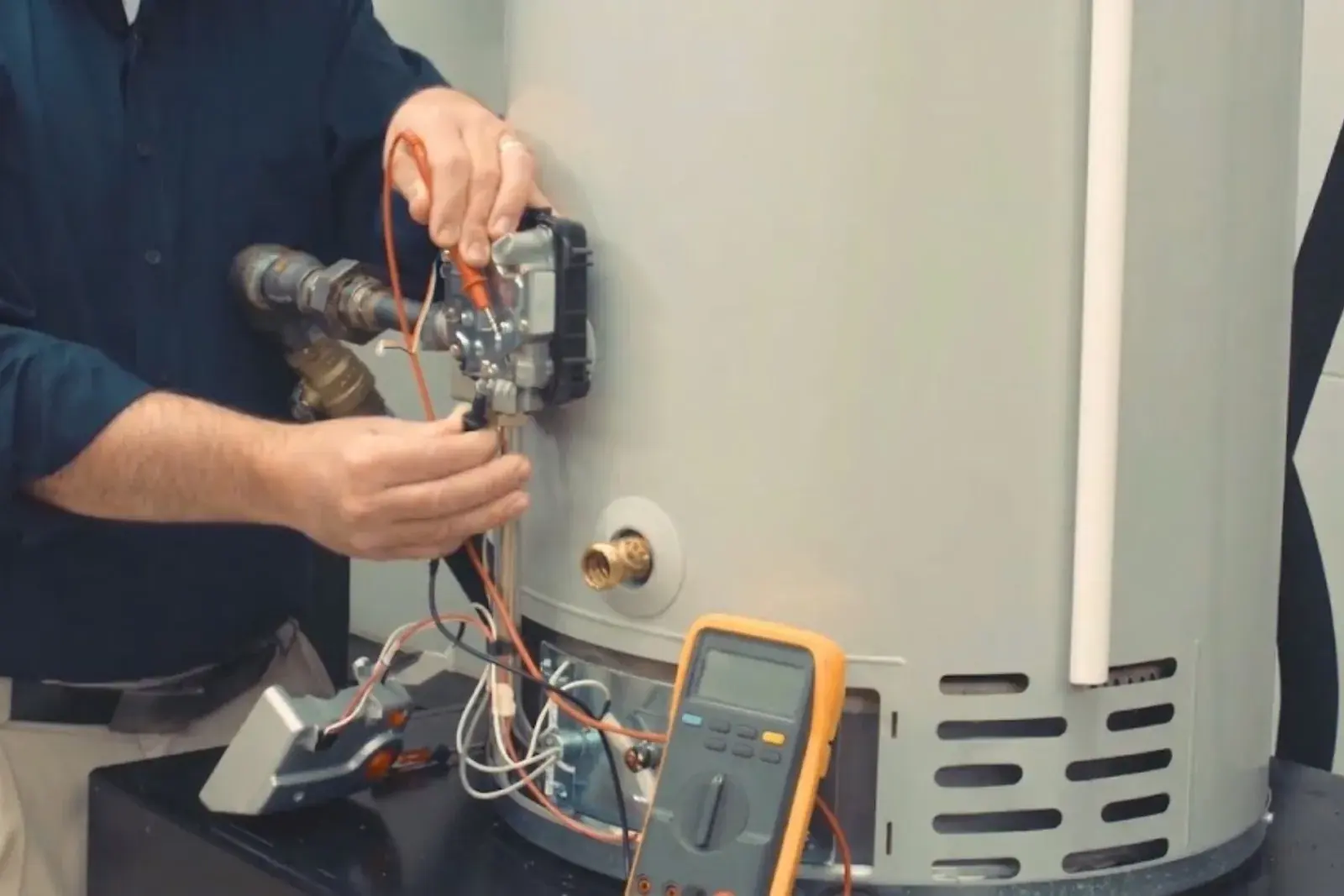
The fastest checks come first. We confirm the breaker or gas supply, then test the thermostats and heating elements with a multimeter on an electric tank, or the pilot assembly, thermocouple and gas valve on a gas unit.
Water temperature at the tap tells us a lot. Hot at first then cold points to the lower element or a dip tube. Never hot points to the upper element, a thermostat or a tripped high-limit switch. A heater that works but runs out quickly is a capacity or sediment problem, not a dead unit.
If the problem is the tank itself, we say so on the spot and show you the options on our water heater replacement page.
Electric, gas and hybrid heat pump water heaters
Each type fails in its own way, so each gets its own diagnosis.
Electric tank heaters
Two heating elements and two thermostats do the work. A failed element or thermostat is a repair measured in parts, not a new tank. We also test the wiring and the high-limit reset.
Gas tank heaters
A pilot that will not stay lit often means a worn thermocouple. Burner flame, vent draft and gas valve operation are checked before any part is replaced. A scorched vent or a smell of gas is a stop-work item.
Hybrid heat pump heaters
These add a compressor and fan on top of the tank, with fault codes for airflow, sensors and condensate. A drain line clogged with algae or dust is a common cause. Some faults are covered by the manufacturer, so keep the model label handy.
Repair or replace: a simple decision guide
We give you both numbers when the answer is close. This table shows how we think about it.
| Situation | Usually | Why |
|---|---|---|
| Tank body is leaking | Replace | Rust-through cannot be patched safely |
| Failed element or thermostat on a newer electric tank | Repair | The part is small and the tank is sound |
| Pilot or thermocouple on a gas tank | Repair | Ignition parts wear before the tank does |
| Tank is old and also needs a costly part | Compare both | Repeated repairs on an aged tank add up |
| Rumbling from sediment | Flush, then reassess | Flushing may help, but heavy scale can mean the end |
| Tankless unit with error code | Repair or descale | Flow and scale faults are fixable, see tankless water heater |
No repair is made without telling you the price first.
Why a leaking water heater cannot wait
Most leak calls come from garage and closet installations where the floor is concrete and nobody is watching the tank. A slow drip can run for weeks before anyone notices.
By then the slab, stored items and any drywall have taken water. When a tank is dripping, stopping it quickly is cheaper than drying out later. If water is showing up on a ceiling or the source is unclear, our leak detection service can trace it.
What matters in Coconut Creek
Local conditions shape how water heaters age and what to watch for.
Treated, softened supply
Water in this area is softened at the Broward County plant that supplies the city utility and disinfected with chloramines. Ask your utility for its water quality report, since sediment and scale behavior depends on the actual water, not on guesses.
Storm season outages
The Atlantic hurricane season runs from June 1 to November 30. After a long power loss, an electric heater may trip its breaker or a gas pilot may need relighting, so check both before assuming the unit has failed.
Garage and closet installs
Tanks tucked into garages or utility closets need a drain pan and a clear path for the relief line. If your heater sits above finished space, a pan matters even more.
Two utilities across the city
Homes north of Coconut Creek Parkway are on the city utility and those south are on Margate utility. If hot water looks discolored in both hot and cold taps, call your utility. If only hot water is affected, the heater is the likely cause.
What a water heater repair visit looks like
- 1
Safety check
We shut off power or gas and water, and check for leaks, venting and relief valve discharge.
- 2
Diagnosis
Electrical tests, burner checks or fault code reading identify the actual failed part.
- 3
Options with a price
You get the repair cost, and the replacement cost if the tank is the problem.
- 4
Repair and test
After the fix we refill, restore power or gas, check temperature and test the relief valve.
What affects the cost of water heater repair
Repair cost follows the part and the labor to reach it, not a flat rate. These are the factors.
Type of unit
Elements and thermostats are inexpensive next to a gas valve or heat pump component.
Part availability
Common parts are on the truck, while unusual models may need ordering.
Tank age and condition
Putting money into a tank near the end of its life rarely pays off.
Access and location
A garage floor unit is quicker to work on than one in an attic.
After-hours timing
Night and weekend calls can carry a different rate, stated up front.
Homeowner insurance usually covers sudden water damage from a failed tank, such as a split seam that floods a room, but not the cost of replacing the heater itself. Wear and tear is typically excluded, so read your policy or ask your agent.
Want the real figure for your unit? Call and give us the make and model label.
Call (855) 575-2890Before you call, gather this
A few details speed up the visit.
- The make, model and age from the data label on the tank.
- Whether the unit is electric, gas, tankless or a heat pump hybrid.
- What you saw: water on the floor, no hot water, noise, an error code.
- Photos of any wet area and of the relief valve and its pipe.
- The location of the breaker, gas shutoff and cold water valve.
Water heater repair questions from Coconut Creek homeowners
Yes. Our line is open 24/7 and we dispatch water heater emergencies across Coconut Creek on nights, weekends and holidays. Shut off the power or gas and the cold water supply first, then call.
A fitting or drain valve leak can be fixed. Water coming from the tank body, or from the bottom after the tank has been in service a long time, usually means the inner tank has corroded and the unit needs replacement. We confirm which before any work.
Check the breaker for electric units and the pilot or gas supply for gas units. If those are fine, a failed element, thermostat or ignition part is likely. We test each one rather than guess.
The usual causes are a failed lower element, a broken dip tube that sends cold water straight to the outlet, or sediment taking up tank space. A flush can help with sediment, and a test shows which one applies.
It is typically a bacterial reaction in the tank and not a health emergency, but gas smells are different. If you smell gas near a gas heater, leave the home and call the gas utility or 911 first.
Yes, in most cases. Tankless faults are often flow, ignition or scale related, and heat pump hybrids can have fan, sensor or condensate issues. Details are on our tankless water heater page.
Use the Florida Department of Business and Professional Regulation license search and its Verify a Licensee option. You can search by name or license number before approving any work.
Yes. We dispatch to Margate, Coral Springs, Parkland and Deerfield Beach from Coconut Creek. Give us the address when you call and we confirm coverage.