
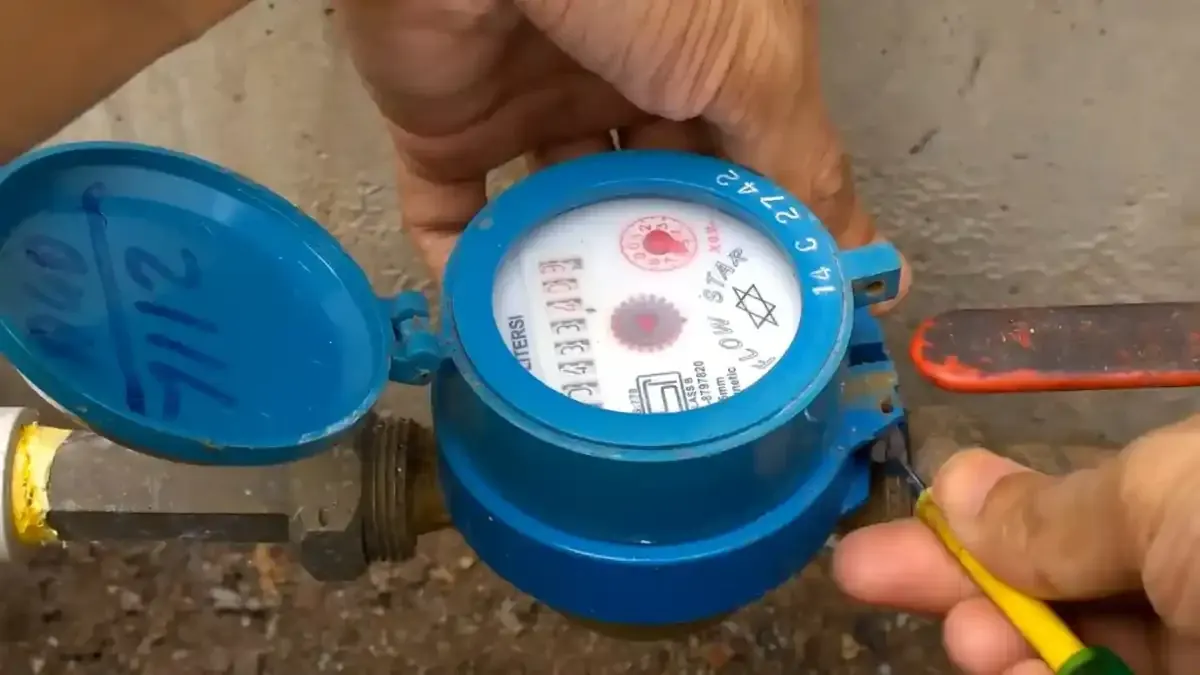
Start with the water meter
A water meter counts every gallon that passes through the line, so it also catches the ones you did not mean to use. Find the meter in the box near the street or at the side of the house and lift the lid carefully, since insects and debris sometimes collect under it.
Turn off every fixture, the ice maker, the washing machine and the irrigation timer. Read the meter or look at the small low-flow indicator, a dial or triangle that spins at very slow flow. Wait fifteen minutes, then check again. Any movement means water is escaping somewhere.
The three-test sequence
Run these in order. Each narrows where the leak can be.
- 1
Meter test
With everything off, watch the indicator. If it moves, you have a leak somewhere between the meter and the fixtures.
- 2
Main shutoff test
Close the main valve at the house and check the meter again. If it stops, the leak is inside. If it keeps moving, it is in the line between the meter and the house.
- 3
Fixture tests
Check toilets, outdoor spigots, the water heater and irrigation lines one at a time to find which one is the source.
Meter moving with everything off?
Call the 24/7 line. We locate hidden leaks without opening walls and explain the repair options first.
The toilet dye test
A toilet that leaks silently from the tank into the bowl can waste a lot of water and rarely makes noise. Take the lid off the tank, add a few drops of food coloring and wait fifteen minutes without flushing.
If color appears in the bowl, the flapper is not sealing. A worn flapper is one of the cheapest leaks to fix and one of the most common. See our toilet repair page if the problem is bigger than the flapper.
Where to look for each symptom
Match what you see to the most likely place. This helps you decide whether the problem is inside or outside the house.
| Symptom | Likely area | First check |
|---|---|---|
| Meter moves, yard is wet | Line between meter and house | Main shutoff test |
| Meter moves, stain on ceiling | Supply or drain line above | Look for water pooling in the room above |
| Warm spot on floor | Hot water line, often under a slab | Hold a hand to the floor, see slab leak repair |
| Wet baseboard or musty smell | Wall or cabinet leak | Check under sinks and around the water heater |
| Low pressure everywhere | Main line or pressure regulator | Check the meter and any wet ground near it |
| Meter moves only at night | Irrigation or a sleeping fixture | Check sprinkler zones and outdoor spigots |
Quick checks you can do in minutes
These cost nothing and rule out the usual suspects.
- Look under every sink for drips, damp wood or a musty smell.
- Check the base of the water heater for rust, puddles or corrosion on the fittings.
- Inspect washing machine hoses and the valves behind them.
- Walk the yard and look for soft or unusually green ground near the line.
- Check the ceiling in rooms below bathrooms for stains or bubbling paint.
Which utility reads your meter, and what the sprinkler rules say
The City of Coconut Creek utility serves residents north of Coconut Creek Parkway, and residents south of the Parkway are served by the City of Margate utility. If your meter test shows a leak, the meter itself belongs to the utility, so a damaged meter or a leaking connection at the meter box is their call.
The sprinkler schedule is also worth checking before you decide a lawn is leaking. Broward County restricts irrigation year-round, with no watering on Monday, Tuesday or Friday and only before 10 a.m. or after 4 p.m. on permitted days. A sprinkler running outside those windows may be a timer problem, and a wet lawn on a no-water day is a good reason to look at the irrigation valves.
Source: the City of Coconut Creek water services page and the Broward County irrigation restrictions page (municipal and county agency pages).
When to stop and call a plumber
If the main shutoff test shows the leak is in the buried line or under the slab, you cannot find it by looking. That is when listening equipment and thermal imaging save the most time and damage.
Our water line repair team handles leaks in the line from the meter to the house, and our leak detection technicians pinpoint leaks inside the walls and floors. Customers in Margate and Parkland call us for the same tests.
Do it yourself or call
Home tests are worth the time. They have limits.
You can handle
- Reading the meter and running the shutoff test.
- Dye testing toilets.
- Checking visible fixtures and hoses.
- Shutting off the main and photographing damage.
Call a pro for
- A moving meter when every fixture checks out.
- Warm spots, hissing or wet ground you cannot trace.
- Water coming through a ceiling or wall.
- Any leak near electrical equipment.
Finding a leak: common questions
Fifteen minutes is enough for most leaks. A very slow leak may need a longer wait or a second reading after an hour with every fixture still off.
A toilet that runs or leaks silently into the bowl can use a surprising amount of water over a month. The dye test is the fastest way to rule it in or out.
Then the leak is inside the house, on the side of the valve. Check fixtures, the water heater and any visible lines, and call a plumber if you cannot find it.
The leak is in the line between the meter and the house. Shut the water off at the meter if you can, and call us to trace the buried line.
Not always. A high bill can come from irrigation, a pool fill or higher use. A moving meter with everything off is the clearest sign of a leak.
The utility that sends your bill. North of Coconut Creek Parkway that is the City of Coconut Creek, and south of it is the City of Margate. We repair the pipe on your side of the meter.