
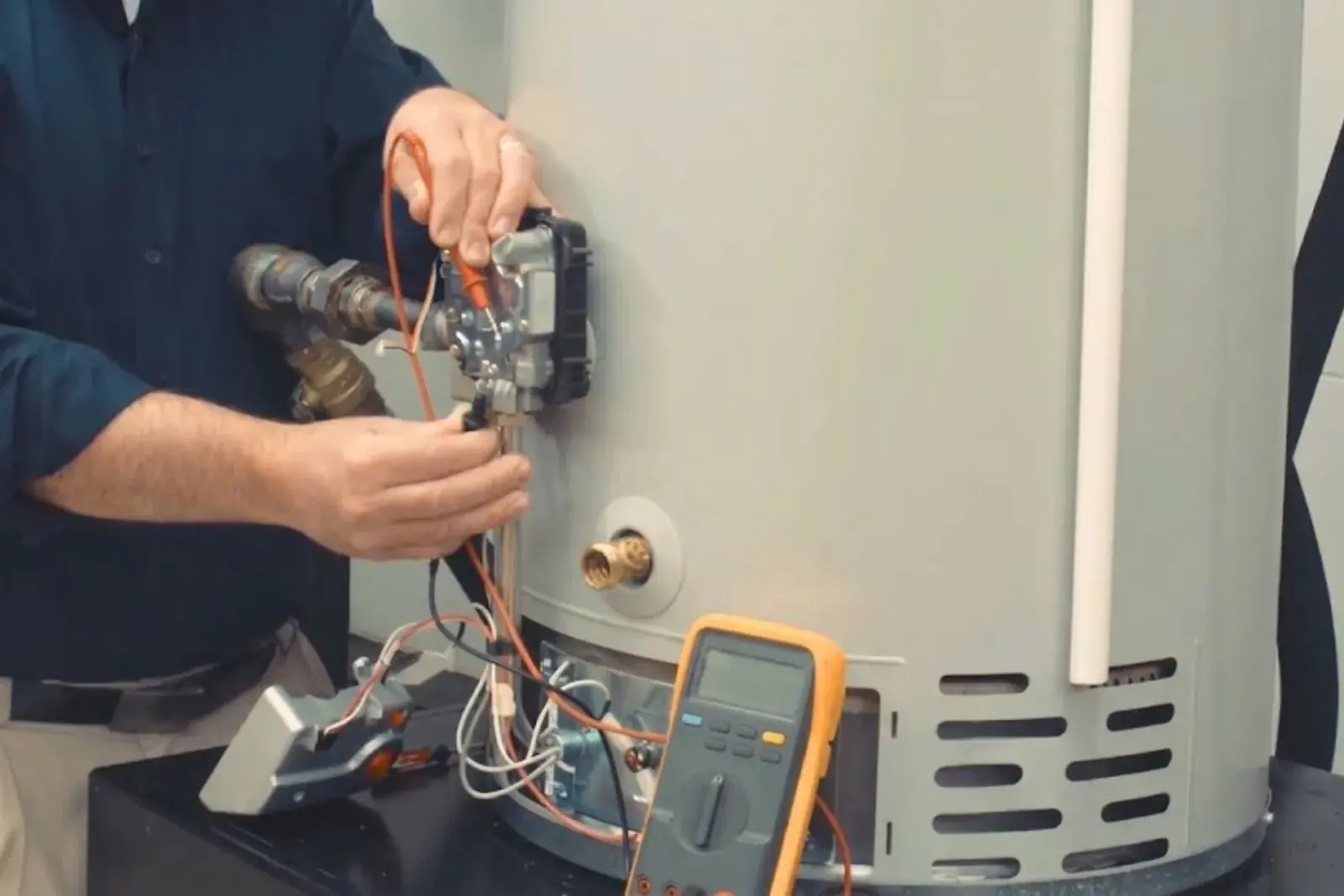
Check that the element is really the problem
This guide applies to electric tank heaters only. A gas heater has no elements, and a tankless unit has a different heating system. If you are not sure which type you have, the data plate on the side of the tank will say.
An electric tank usually has two elements, one near the top and one near the bottom. If the water is lukewarm, the lower element or a thermostat is a likely suspect. If you get a short burst of hot water and then cold, the upper element often fails. A tripped breaker or a tripped reset button on the heater can also cause the same symptoms.
Signs a heating element has failed
A bad element rarely fails all at once. These are the patterns we hear most.
Only lukewarm water
The thermostat is set high and the water still never gets properly hot.
Hot water runs out fast
Showers that used to last now turn cold halfway through.
The breaker trips
The breaker for the heater trips each time the heater tries to heat.
Humming or sizzling
A sizzling or humming sound from the tank can mean scale on the element.
Old tank, heavy sediment
Sediment around the lower element makes it burn out sooner.
Rather not work next to 240 volts?
Call the 24/7 line and a licensed plumber can test and replace the element for you.
Safety first: power off and proven dead
A water heater element runs on 240 volts, which can seriously injure or kill. Do these before you touch anything.
Switch off the breaker
Turn off the heater breaker at the panel and tape it so nobody switches it back on.
Remove the cover
Take off the access panel and push aside the insulation.
Test the wires
Check the terminals with a non-contact tester or a multimeter. If you cannot confirm the power is off, stop and call a licensed plumber.
How to replace an element, in order
Gather a multimeter, an element wrench, a replacement element that matches the voltage and wattage on the old one, and a bucket. Then work through these steps.
- 1
Kill and verify power
Switch off the breaker, remove the access panel and insulation, and test that the terminals read zero volts.
- 2
Test the element
Disconnect the wires, set the meter to resistance and touch the leads to the element terminals. A reading near zero or an open circuit points to a bad element.
- 3
Close the supply and drain
Shut the cold water valve, open a hot tap upstairs and drain the tank below the element level through the drain valve.
- 4
Unscrew and swap
Use the element wrench to remove the old element, fit the new one with its gasket and tighten it by hand and then wrench.
- 5
Refill before power
Open the cold valve with a hot tap open until water flows steadily, then restore power. Never power an element that is not underwater.
What the multimeter tells you
A resistance test is the simplest check you can do.
| Reading | Meaning | Next move |
|---|---|---|
| A steady resistance in the expected range | Element is likely good | Check the thermostat and breaker |
| Open circuit or infinite resistance | Element has failed | Replace the element |
| Continuity from terminal to tank | Element is shorted to ground | Replace the element and check for water inside the cover |
| No power at the terminals with the breaker on | Upstream problem | Check the breaker, reset button and wiring |
Why dry-firing destroys the new element
An element heats metal, and the tank water carries that heat away. If you power the element while the tank is still empty, it overheats in seconds and burns out. This is the mistake that turns a ten-minute repair into a second trip to the store.
The fix is simple. Keep a hot tap open as the tank fills and wait for a steady stream with no sputtering before the breaker goes back on.
Replace the element or replace the heater
A new element is cheap compared with a new tank, but only when the tank is sound.
Replace the element
- Heater is young and shows no leaks at the base or seams.
- Test points to one failed element and sediment is moderate.
- The job fits in a single visit.
Replace the heater
- Tank leaks, rusts at the seams or is past its normal service life.
- Sediment is heavy and elements keep burning out.
- See water heater replacement for what a new tank involves.
When to stop and call a plumber
Call if the wiring looks melted or scorched, if the element will not budge, or if you see water leaking from the tank body. A frozen element fitting can strip its threads and turn a small repair into a tank replacement. A licensed plumber has the right wrenches and the meter to confirm the diagnosis.
You can also hand the job over from the start. Our crews handle it under water heater repair, and the same visit covers the thermostat and the relief valve.
Coconut Creek note: when power returns after a storm
Hurricane Wilma made landfall on October 24, 2005, as a Category 3 storm, and the National Weather Service reports that its eye covered most of Broward County. We do not claim a specific Coconut Creek impact from that storm. The point for homeowners is the pattern: storms in this region often interrupt power, and the return of power is a moment when water heaters deserve a check.
When power comes back, check that the breaker has not tripped, that the tank is full before you switch the heater on and that you see no leaks around the base. A heater that lost power for a long stretch can show element or thermostat trouble the first time it restarts. If the tank was submerged in flood water, do not switch it on, and call a licensed plumber and an electrician.
Source: National Weather Service summary of Hurricane Wilma in South Florida.
If you live nearby
Homeowners in Coral Springs and Parkland call us when the lower element fails after years of sediment. The test and the swap are the same in every town, and so is the safety rule about power.
Water heater element questions
Common signs are lukewarm water, hot water that runs out fast, a tripping breaker or a humming tank. A multimeter resistance test on the element terminals confirms it.
No. You must drain the tank below the element level, or water will pour out when you unscrew it. Shut the water, open a hot tap and drain first.
Not always, but if one has failed and the heater is several years old, many plumbers replace both in the same visit. The upper and lower elements work together, and heavy sediment affects the lower one first.
Match the voltage and wattage printed on the old element and on the heater data plate. The thread type and the length also matter, so bring the old part to the store.
It can be, if you switch off the breaker, prove the wires dead with a tester and keep the tank full before powering on. If you are unsure, hire a licensed plumber.
After a power outage, check the breaker, confirm the tank is full and look for leaks before switching the heater on. If the heater was in flood water, leave it off and call a licensed plumber and an electrician.